Bizarre Creatures Thriving in Earth’s Most Extreme Places
Meet bizarre creatures thriving in Earth’s most extreme places — from boiling vents to frozen glaciers, life finds a way in the strangest corners of our planet 🌍🧬
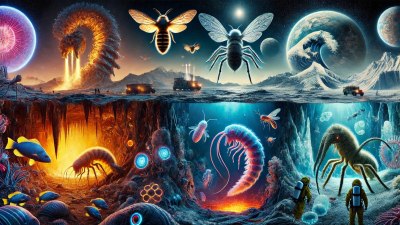
This image was created with the assistance of DALL·E
You might think life on Earth needs sunshine, fresh air, and comfy temperatures to survive. But nature loves a challenge — and some of the planet’s strangest, most jaw-dropping creatures are thriving in places that seem downright impossible for life.
From boiling acid pools to deep-sea trenches darker than midnight, here are the bizarre organisms that have not only adapted to Earth’s harshest conditions — they’re absolutely thriving there.
Tardigrades — The Tiny Titans of Survival
Let’s start with the ultimate champion of extreme life: the tardigrade, also known as the water bear.
These microscopic creatures may look squishy and cute under a microscope, but they are nearly indestructible. Tardigrades have been found:
- In the freezing cold of Antarctica
- Boiling hot springs
- The vacuum of space (seriously)
- Radiation-filled environments
When conditions get rough, they enter a cryptobiotic state — basically shutting themselves down like a computer — and wait for things to improve. Some scientists think tardigrades could even survive the end of the world. Not bad for something smaller than a grain of sand.
Halomonas titanicae — Bacteria That Eat Rust (and the Titanic)
Down in the salty, dark depths of the ocean where the Titanic rests, scientists discovered a bizarre bacteria called Halomonas titanicae.
This microscopic creature doesn’t just survive on the wreckage — it feeds on it. It consumes iron and contributes to the slow breakdown of metal structures underwater. It’s thriving in conditions where pressure would crush most life, and where temperatures are icy cold.
Researchers think it could one day help design biodegradable metal or clean up underwater wreckage. But it also means the Titanic won’t be around forever.
The Pompeii Worm — Life in Boiling Water
Imagine living next to a volcano. Now imagine living in a boiling-hot underwater volcano vent, and you’ve got the Pompeii worm.
These odd-looking worms hang out on hydrothermal vents deep in the ocean, where temperatures can reach over 175°F (80°C). Their secret? They’re coated in a layer of bacteria that helps insulate and protect them.
Despite the heat, crushing pressure, and complete darkness, these worms seem perfectly content in their steamy homes — making them some of the hottest creatures on Earth, literally.
Ice Worms — Yes, They’re Real
Not all bizarre creatures love the heat. Some, like ice worms, have evolved to thrive in glaciers and frozen tundra.
These squishy black worms live inside glaciers, moving slowly through tiny channels in the ice. They’re so temperature-sensitive that if they warm up just a few degrees, they can die — talk about being committed to cold living.
You can find them wriggling around on the surface of glaciers in Alaska during the summer months, especially at dusk. Yes, worms in ice. Earth is weird.
Thermoacidophiles — Creatures of Heat and Acid
With a name that sounds like something from a sci-fi villain roster, thermoacidophiles are microscopic organisms that love two things: heat and acid.
They live in places like volcanic springs and sulfur pits, where temperatures soar above 160°F (70°C) and the environment is as acidic as battery fluid. In Yellowstone National Park’s colorful hot springs, these microbes are partly responsible for the rainbow hues — their pigments help them survive extreme conditions.
They’re technically a type of archaea (kind of like bacteria’s weird cousin) and remind us that life can survive in places that look completely uninhabitable.
Deep-Sea Anglerfish — The Monster of the Abyss
Imagine a creature that lurks miles below the ocean’s surface, in total darkness, waiting patiently with a glowing lure dangling from its head. Meet the deep-sea anglerfish.
This toothy terror thrives in an environment with:
- Zero sunlight
- Crushing pressure
- Temperatures just above freezing
The female anglerfish uses bioluminescence to attract prey — and mates. In some species, the male literally fuses to the female’s body and becomes part of her, surviving as a permanent parasite. Romance looks a little different in the deep sea.
Brine Shrimp — The Survivors of Salt
Brine shrimp, often called sea monkeys, are way more hardcore than their silly toy reputation suggests.
They live in extremely salty environments, like Utah’s Great Salt Lake or Africa’s Lake Natron, where few other creatures can survive. Some species even live in water so salty it would kill most fish instantly.
To make things even stranger, brine shrimp can survive dried out for years. Their eggs enter a dormant state and can hatch again when rehydrated. That’s some serious life insurance.
The Devil Worm — Deepest Animal Ever Found
With a name like devil worm, you know this creature is going to be weird.
Discovered over two miles underground, in water-filled cracks deep in South African gold mines, the devil worm (Halicephalobus mephisto) is the deepest-living multicellular organism ever found. It survives intense pressure, heat, and nearly no oxygen.
Finding it was a complete surprise — and it made scientists rethink what’s possible, especially when it comes to searching for life deep beneath the surface of other planets.
What These Creatures Teach Us About Life (on Earth and Beyond)
So why should we care about bizarre creatures that live in places most of us will never visit? Because they’re proof that life is way more adaptable and creative than we imagined.
Studying extremophiles (that’s the fancy name for life in extreme places) helps scientists:
- Understand the limits of life on Earth
- Develop better tools for medicine, technology, and even clean energy
- Prepare for missions to Mars, Europa, and other worlds where extreme conditions are the norm
These creatures are like nature’s survival experts — and they might just be the key to finding life beyond Earth.
Weird, Wild, and Wonderfully Tough
From boiling vents to frozen glaciers, life on Earth has found a way to thrive in just about every extreme environment imaginable. These bizarre creatures challenge our ideas of what’s possible and show that being strange might actually be the best survival strategy.
So the next time someone says life can’t exist somewhere, remember the tardigrade, the Pompeii worm, and the devil worm — and smile, because Earth is still full of surprises.
What Do You Think?
Which of these creatures blew your mind the most? Would you want to visit any of these extreme places (safely, of course)? Drop a comment and share this article with your favorite science-loving friend.