Why Space Might Be More Dangerous Than We Ever Imagined
Space isn’t peaceful — it’s packed with radiation, debris, and cosmic chaos. Discover the surprising ways the universe is more dangerous than we ever imagined 🚀🌌

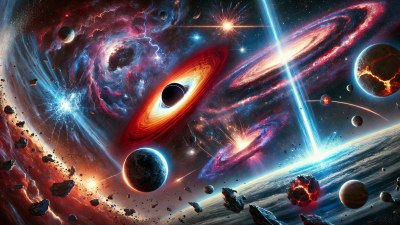
Photo via Canva.com/AI Generated Image
We often picture space as a peaceful frontier — silent, vast, and full of twinkling stars. But behind that calm, black canvas lies a reality that’s far more hostile and unpredictable than we might like to admit.
The truth is, space isn’t just an empty void. It’s a danger zone filled with invisible radiation, high-speed debris, and forces so extreme they warp time and bend light. As we prepare to explore further than ever before, it’s becoming clear: space might be far more dangerous than we ever imagined.
Here’s a closer look at the hidden hazards waiting beyond our atmosphere — and why astronauts, scientists, and space agencies are taking them very seriously.
Radiation: The Invisible Threat
On Earth, we’re protected from most cosmic radiation by our atmosphere and magnetic field. But in space? That protection vanishes.
Space is full of:
- Cosmic rays from distant stars and galaxies
- Solar radiation from flares and coronal mass ejections
- Gamma rays from powerful cosmic events
These high-energy particles can:
- Damage human cells and DNA
- Increase cancer risk in astronauts
- Fry spacecraft electronics
Long-term exposure is one of the biggest concerns for missions to the Moon, Mars, or beyond. Shielding is possible — but not perfect. And the deeper into space we go, the harder it becomes to protect against the constant radiation bombardment.
Microgravity Wreaks Havoc on the Human Body
Floating in zero gravity might look fun, but it takes a serious toll on the body.
In microgravity, astronauts experience:
- Muscle loss and bone thinning
- Vision problems due to fluid shifting
- Weakened immune responses
- Changes in the brain and even gene expression
The longer someone stays in space, the more their body unlearns Earth’s environment. Re-adapting to gravity after months away can feel like recovering from a long illness.
And for multi-year missions, like those planned for Mars, microgravity could become a major health challenge unless we find ways to simulate gravity or counteract its effects.
Space Junk Is a Real and Growing Problem
Earth’s orbit isn’t empty. It’s cluttered with thousands of pieces of debris — broken satellites, spent rocket parts, and tiny fragments from past collisions.
This space junk moves at speeds of up to 17,500 mph, fast enough to turn a paint chip into a bullet. Even small pieces can:
- Punch holes in spacecraft or space stations
- Damage solar panels, sensors, or windows
- Endanger astronauts on spacewalks
There are systems to track large debris, but avoiding smaller pieces is nearly impossible. As space gets more crowded, the risk of collisions — and chain reactions of more debris — increases.
It’s a problem that’s not just dangerous — it’s growing fast.
The Psychological Toll of Deep Space
Being in space isn’t just physically tough — it’s mentally and emotionally challenging, too.
Astronauts in low Earth orbit already face:
- Isolation from family and friends
- Disrupted sleep cycles due to lack of a normal day-night rhythm
- High-pressure environments with zero room for mistakes
Now imagine being months away from Earth, with no real-time communication, no emergency return plan, and nothing but the same crew and the same walls around you.
Psychological strain is one of the biggest unknowns for deep space travel. Even highly trained astronauts can face anxiety, depression, and stress when placed in extreme isolation for long periods.
Gravity Wells and Fuel Limits
Space travel isn't just about going somewhere — it’s about getting back.
Planets and moons have gravity wells, which require massive amounts of energy to escape. Getting off Earth takes a lot of fuel. But taking off from Mars, or an asteroid, presents a different set of challenges.
The farther we go, the more we need:
- Fuel-efficient propulsion systems
- Reliable ways to harvest resources in space
- New tech to make return trips possible
One mistake in planning or fuel calculations could leave a crew stranded — with no rescue options.
Alien Microbes: Not the Sci-Fi Kind
No, we’re not talking about bug-eyed aliens in flying saucers. But if we do find life beyond Earth, it might be microscopic — and dangerous.
Unknown microbes from other worlds could pose threats such as:
- Toxic biochemistry
- Unpredictable mutations in Earth environments
- Contamination of planetary ecosystems — ours or theirs
NASA and other space agencies follow strict planetary protection protocols to avoid contamination in both directions. But as exploration ramps up, the biological risks will only grow.
Unpredictable Cosmic Events
The universe is full of surprises, and some of them are pretty terrifying.
Here are just a few:
- Solar flares that could knock out communications or power systems
- Asteroid impacts from space rocks we haven’t spotted yet
- Black holes and gravitational distortions that defy understanding
- Gamma-ray bursts that could sterilize entire planets
Most of these events are incredibly rare. But the fact that they’re even possible is a reminder that space is not a calm or stable place.
Final Thoughts: Brave, But Not Easy
Space exploration is one of humanity’s greatest adventures — but it’s also one of the riskiest. The more we learn, the more we realize how much we don’t know. Space is not just cold and quiet. It’s wild, unpredictable, and full of danger.
And yet, that’s part of what makes it so thrilling.
With smart engineering, creative problem-solving, and a deep respect for the risks, we’re still heading out there. But let’s not forget: space may be the final frontier, but it’s also the most dangerous one we’ve ever attempted to cross.
What Do You Think?
Do the dangers of space make you more excited or more cautious about future missions? What challenge do you think is the hardest to overcome? Share your thoughts in the comments — and send this to a friend who’s dreaming of the stars.