The Truth About Black Holes That Will Change How You See the Universe
Black holes bend time, defy physics, and may hold the secrets of the universe. Discover the truths that make these cosmic giants more fascinating than fiction 🌌🕳️

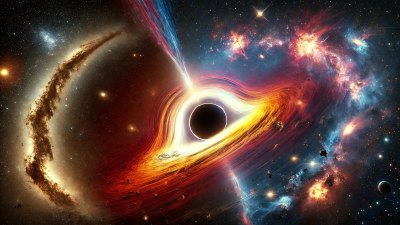
This image was created with the assistance of DALL·E
They’ve been called cosmic monsters, space-time whirlpools, and even portals to other dimensions. Black holes have captured our imagination like no other astronomical object — and for good reason. They're mysterious, terrifying, and completely fascinating.
But the truth about black holes is even stranger than science fiction. These invisible giants are not just out there gobbling up stars. They’re rewriting the rules of physics and reshaping how we understand the universe itself.
So what exactly are black holes? And what secrets do they hold? Here's the reality behind these cosmic enigmas — and why knowing it might change the way you see everything.
Black Holes Aren’t Just Empty Space
Despite the name, a black hole isn’t a hole at all. It’s a region of space where gravity is so intense that nothing — not even light — can escape. That’s why they appear completely black.
Black holes form when massive stars die and collapse under their own gravity. But instead of disappearing, they compress into an incredibly dense point called a singularity, surrounded by a boundary known as the event horizon.
The singularity is where all the mass is packed into a space so small that the laws of physics break down. And that’s not an exaggeration — even Einstein’s equations stop working there.
Time Gets Really Weird Near a Black Hole
Approach a black hole, and time doesn’t just slow down — it practically stops.
This mind-bending effect is called gravitational time dilation, and it’s been confirmed by real science. The stronger the gravity, the slower time moves. So if you spent a few minutes orbiting a black hole and then returned to Earth, decades or even centuries could have passed here.
Yes, it’s like a one-way trip to the future. Except you probably wouldn’t survive the ride. But the fact that black holes affect time itself? That’s one of the wildest truths about the universe.
Black Holes Can Be Tiny or Gigantic
Not all black holes are supermassive beasts lurking in the centers of galaxies (though those exist too). In fact, black holes come in different sizes:
- Stellar black holes are formed from dying stars and are just a few times more massive than the Sun.
- Intermediate black holes are still a mystery — scientists are hunting for them in star clusters.
- Supermassive black holes contain millions or billions of solar masses and sit in the hearts of galaxies.
- And theoretically, primordial black holes could be microscopic, formed in the early universe.
Some black holes are smaller than cities. Others are bigger than entire solar systems. The variety is staggering.
You’d Never Survive Falling Into One (But It’s Fun to Imagine)
If you jumped into a black hole, things would get weird fast. As you got closer to the event horizon, tidal forces would stretch your body like spaghetti — yes, scientists actually call it "spaghettification."
At the same time, anyone watching from a safe distance would see you appear to freeze at the edge, your image slowly fading as light from you redshifts away.
And if you passed the event horizon? You’d be cut off from the universe forever. No signals, no light, no escape. Just a one-way trip to... somewhere. Maybe the singularity. Maybe another universe. No one really knows.
Some Black Holes Might Not Be Black at All
Stephen Hawking theorized that black holes aren’t completely black. According to his work, they slowly emit particles over time — a process called Hawking radiation.
This radiation causes black holes to lose mass and evaporate over billions or trillions of years. Eventually, they could disappear entirely.
It’s a mind-blowing idea: something that can consume entire stars might one day fade away into nothing. That’s not something you usually expect from cosmic death traps.
We Can’t See Them — But We Can Hear Their Effects
Black holes are invisible to the naked eye, but we can detect their presence in several ways:
- By watching stars orbiting something invisible
- By observing X-rays and gamma rays from matter being heated as it falls in
- And now, by listening to gravitational waves — ripples in space-time caused by black holes merging
These gravitational waves were first detected in 2015, and they opened a whole new way of studying the universe. We're now hearing the cosmic symphony of colliding black holes across the galaxy.
They Might Be Key to Understanding the Entire Universe
Black holes sit at the intersection of quantum mechanics and general relativity, the two pillars of modern physics — but the two don’t agree on what happens inside a black hole.
That makes black holes ground zero for discovering new physics. Understanding them could help us finally unlock a unified theory of everything — something scientists have been chasing for decades.
They might even be connected to the beginning of the universe, dark matter, or alternate dimensions. In other words, black holes may hold the answers to the biggest questions we've ever asked.
Final Thoughts: Black Holes Are More Than Just Space Oddities
It’s easy to think of black holes as cosmic trash compactors — mysterious, deadly, and far away. But they’re actually deeply connected to the structure and evolution of the universe.
They shape galaxies. They challenge our understanding of space and time. And they just might be the key to uncovering what reality is really made of.
The more we learn about black holes, the more we realize how much we don’t know. And that mystery? That’s exactly what makes them so thrilling.
What Do You Think?
Would you want to explore a black hole if it were safe? What do you think happens beyond the event horizon? Share your wildest theories in the comments — and send this to someone who loves staring into the cosmic unknown.