What NASA Just Discovered on Europa Could Change Everything
NASA’s discoveries on Europa point to a hidden ocean, strange chemistry, and signs of life. Here’s why this icy moon could change everything we know 🌌🧬
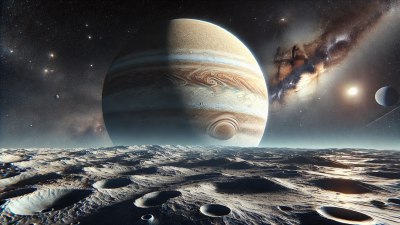
This image was created with the assistance of DALL·E
Jupiter’s icy moon Europa has long been a favorite target for scientists dreaming of alien oceans and hidden life. Covered in a cracked shell of ice and orbiting in the cold outer reaches of the solar system, it might not look like much — but what’s happening beneath the surface could be one of the most important discoveries of our time.
NASA has been keeping a close eye on Europa, and what they’ve recently found might just rewrite what we know about life in the universe.
So what’s lurking under all that ice? And why are scientists so excited? Let’s dive into the mystery — and what it could mean for the future.
A Moon With a Hidden Ocean
Europa isn’t just another frozen rock in space. Underneath its thick crust of ice, scientists believe there’s a massive subsurface ocean — more water than all of Earth’s oceans combined.
What keeps it liquid in such a cold environment? The powerful gravitational pull from Jupiter stretches and squeezes Europa as it orbits, creating frictional heat inside the moon. That internal warmth could be enough to keep the ocean from freezing solid.
And where there’s water, there’s always the question: could there be life?
Water Plumes Erupting From the Surface
NASA and the Hubble Space Telescope have observed plumes of water vapor erupting from Europa’s surface. These geyser-like bursts shoot through cracks in the ice, spewing water hundreds of miles into space.
This is huge for two reasons:
- It means the ocean may be interacting with the surface, creating a potential way to study what’s below without drilling through miles of ice.
- It also shows that Europa is geologically active, which is a key ingredient for life as we know it.
If future missions can fly through or land near these plumes, they could sample the ocean without even landing, offering the best chance yet to search for signs of life beyond Earth.
Signs of Chemistry We Didn’t Expect
Recent analysis suggests that Europa’s surface contains salts and possibly organic molecules — the building blocks of life. These compounds may have come from the ocean below, pushed up through the ice by internal activity.
That means the water down there isn’t just salty — it could be chemically rich, with the right ingredients to support simple life.
And unlike Mars, where life might have existed in the past, Europa’s ocean could be teeming with life right now — if the conditions are right.
Ice That Moves Like Earth’s Tectonic Plates
Scientists have also found evidence that Europa’s ice shell moves and shifts, similar to tectonic plates on Earth. That movement could help circulate nutrients from the surface down into the ocean, and bring heat and materials up from below.
This kind of geological activity could be crucial for creating an environment where life can thrive — a sort of underwater ecosystem powered by the planet’s internal heat, just like hydrothermal vents on the ocean floor here on Earth.
And we already know that Earth’s hydrothermal vents are home to life forms that don’t need sunlight — just heat and chemistry.
Upcoming Missions Aiming for Close Encounters
NASA isn’t stopping at telescopes and flybys. A new mission called Europa Clipper is preparing for launch, with the goal of flying repeatedly past Europa to study its surface, plumes, and magnetic field in detail.
The Clipper will carry instruments that can:
- Analyze the moon’s surface composition
- Detect water under the ice
- Scan for organic molecules
- Look for signs of subsurface activity
And all of it is designed to answer one question: Is Europa habitable?
If the Clipper detects signs of life — even the faintest whisper — it would be one of the most important discoveries in human history.
What If We Found Life on Europa?
Let’s say the signs are there. Maybe it’s microscopic. Maybe it’s alien shrimp near underwater vents. Maybe it’s something totally unexpected.
Whatever it is, finding life on Europa would mean:
- We’re not alone.
- Life doesn’t need Earth-like conditions to evolve.
- The universe may be full of habitable worlds, just waiting to be discovered.
It would change everything — from biology to philosophy to how we think about our place in the cosmos.
And even if we don’t find life, Europa could still teach us how life begins, how oceans behave on alien worlds, and where to search next.
A Tiny Moon With a Big Secret
It’s hard to believe that one of the most promising places to find alien life might be a frozen moon orbiting a gas giant. But Europa is full of surprises — hidden oceans, erupting plumes, and maybe something alive beneath all that ice.
What NASA is discovering there could reshape the future of space exploration, and how we see life in the universe. Whether you’re a science fan, a space nerd, or just someone who’s ever looked up at the stars and wondered what’s out there — Europa is a name worth remembering.
What Do You Think?
If we find life on Europa, what do you think it would look like? Would it change how we see ourselves on Earth? Share your thoughts in the comments — and send this article to someone who’d love to talk space over coffee.